
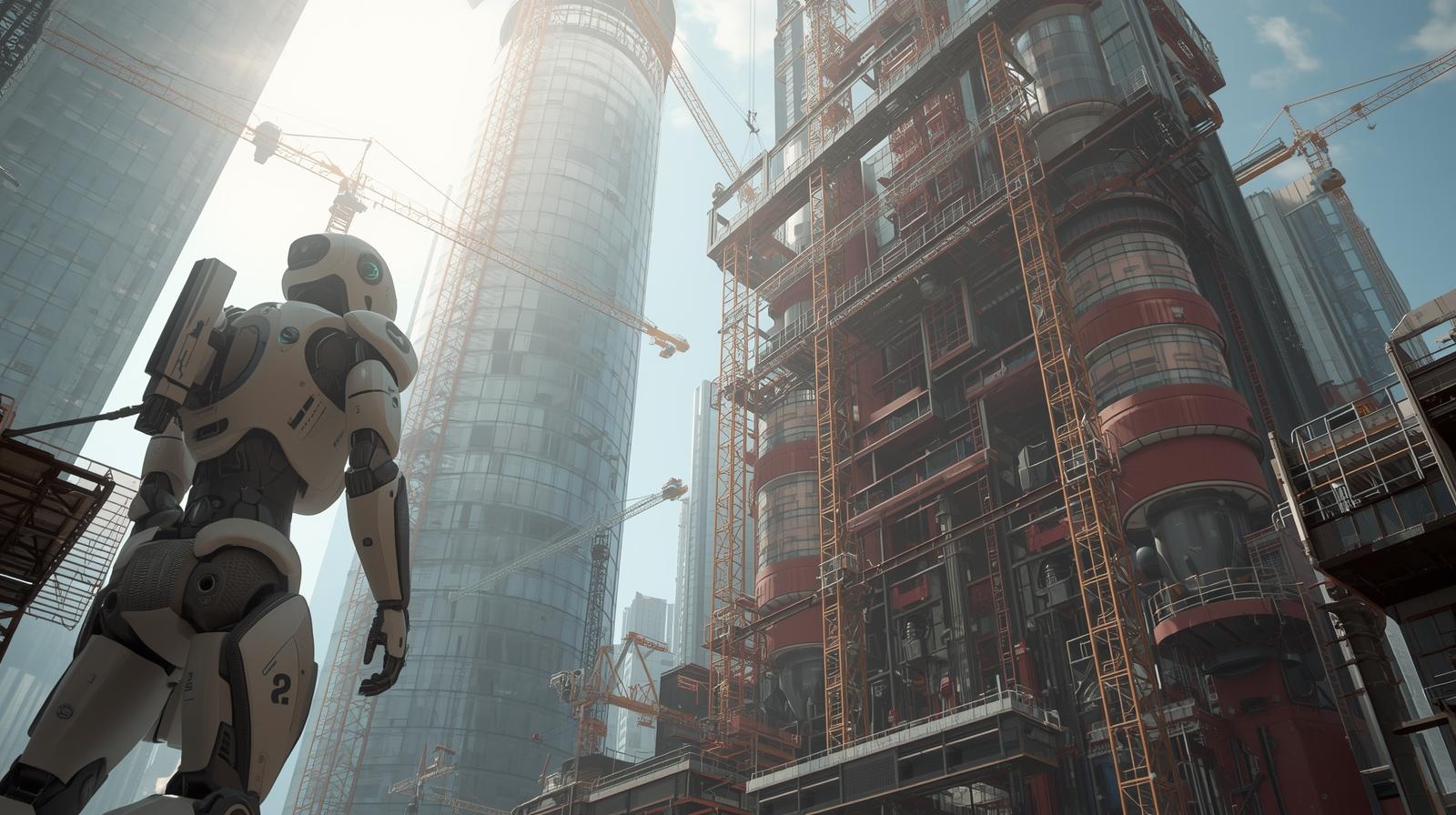
The construction industry is on the edge of an unprecedented transformation. For decades, it has relied heavily on manual labor, human coordination, and traditional equipment. But by 2040, automation and robotics will completely rewrite the playbook.
From AI-driven robots laying bricks to autonomous cranes lifting materials and 3D printers constructing full buildings, the future of construction will be defined by precision, speed, and safety.
This evolution isn’t about replacing people — it’s about using technology to build better, faster, and with fewer risks. Let’s explore what the construction industry of 2040 will look like and how robotics will become its driving force.
1. The Rise of Automated Construction
Automation in construction began with small tasks like surveying, excavation, and materials transport. By 2040, it will touch every phase of a project — from design and planning to completion.
Key developments driving this shift include:
- AI-driven project management: Smart software coordinating multiple machines and human teams.
- Self-operating equipment: Bulldozers, excavators, and cranes that work autonomously using GPS and LiDAR.
- Real-time monitoring: Sensors tracking site productivity, material usage, and safety.
The result will be data-driven construction sites that operate with machine-like precision and minimal downtime.
2. Robotics at the Core of Future Construction
Robotics will be the backbone of the 2040 construction landscape. These aren’t just machines; they’re intelligent collaborators capable of performing high-risk or repetitive tasks with unmatched consistency.
Some key types of robots emerging now and expected to dominate by 2040 include:
- Bricklaying Robots: Already in testing, these systems can lay thousands of bricks per day with near-perfect alignment.
- Rebar Tying Robots: Speeding up structural work while improving accuracy.
- Concrete Printing Robots: Mobile 3D printers capable of constructing entire walls or small buildings directly on-site.
- Demolition Robots: Controlled remotely or through AI systems for precision and safety.
- Finishing Robots: Handling painting, plastering, and polishing tasks faster than human crews.
By 2040, robotic fleets will collaborate seamlessly on large projects — coordinated by AI systems that schedule, monitor, and optimize every operation.
3. The Speed Advantage: Faster Project Delivery
Time is money in construction, and automation delivers both savings and predictability.
Automated systems eliminate delays caused by fatigue, miscommunication, and inconsistent labor output. Robots can work 24 hours a day with precision that rarely needs rework.
Here’s how automation speeds up timelines:
- Continuous operation: Machines can run multiple shifts without breaks.
- Automated sequencing: AI coordinates workflows to minimize idle time.
- Rapid 3D printing: Walls and foundations can be printed in hours instead of weeks.
By 2040, building timelines for certain structures could drop by 30–50%, dramatically improving project turnover and profitability.
4. Precision Engineering and Reduced Human Error
Human error remains a major cause of cost overruns and safety risks. Automation virtually eliminates this variable.
Robotic systems equipped with sensors and cameras can maintain accuracy down to millimeters — something impossible with traditional methods.
For example:
- Automated surveying drones can map a site with centimeter precision.
- AI inspection robots detect structural flaws invisible to the human eye.
- Laser-guided machinery ensures consistent leveling, alignment, and measurements.
By 2040, the concept of “error margins” in construction will be redefined, with digital precision driving flawless execution.
5. Safety Revolution: Fewer Accidents, Safer Sites
Construction sites have always been risky environments. Automation and robotics are set to drastically change that.
By shifting hazardous tasks from humans to machines — such as working at heights, handling heavy loads, or operating in unstable conditions — injury rates will decline dramatically.
Key safety innovations include:
- Autonomous vehicles with anti-collision systems.
- Wearable tech that communicates with nearby robots to prevent accidents.
- AI monitoring systems that detect unsafe behavior or unstable structures.
By 2040, jobsite fatalities could be reduced by more than half, thanks to robotic safety integration and predictive AI supervision.
6. Labor Efficiency and the New Workforce Model
Automation doesn’t eliminate human workers — it redefines their roles. Instead of performing repetitive or dangerous tasks, future workers will supervise, program, and maintain robotic systems.
This will give rise to new roles such as:
- Robotic Equipment Operators
- AI Construction Managers
- Data-Driven Estimators
- Automation Safety Supervisors
By 2040, successful construction professionals will blend engineering expertise with data and software literacy.
Rather than replacing jobs, automation will shift the focus toward higher-skill, higher-paying careers centered on technology oversight and innovation.
7. Integration of AI and Robotics
AI will be the “brain” behind the mechanical systems. It will coordinate, learn, and adapt continuously.
Imagine a future construction site where:
- Drones scan progress every hour.
- AI models compare reality with blueprints in real time.
- Robots adjust their operations automatically based on updated data.
Through machine learning, these systems will improve with every project, gradually reducing errors and boosting productivity. By 2040, construction AI will act like an orchestra conductor — harmonizing hundreds of moving parts into a perfectly timed performance.
8. 3D Printing: The Future of Structural Fabrication
3D printing, or additive manufacturing, is one of the most disruptive technologies in modern construction.
By 2040, large-scale 3D printers will become a standard fixture on job sites. They will handle:
- On-demand component printing to eliminate material waste.
- Custom structural elements tailored to project requirements.
- Eco-friendly printing materials such as recycled concrete and composites.
In developing areas, 3D-printed housing will help solve affordability crises, while in advanced economies, it will enable ultra-custom architecture without skyrocketing costs.
9. Drones and Aerial Robotics for Construction Oversight
Drones will become an integral part of daily construction operations.
By 2040, these aerial systems will go far beyond photography — they’ll perform real-time inspections, measurements, and logistics tracking autonomously.
They will:
- Deliver materials across sites.
- Inspect hard-to-reach areas like high-rise exteriors.
- Track progress with centimeter-level precision.
- Integrate with AI dashboards for live project updates.
Drones will essentially become the eyes and ears of automated construction, ensuring projects stay aligned with their digital plans.
10. Sustainability and Resource Optimization
Automation is not only about speed and accuracy — it’s also key to a more sustainable industry.
Robots and automated systems can minimize waste by cutting materials precisely and optimizing usage in real time. They also consume less energy and enable recycling processes with higher efficiency.
By 2040:
- Robotic systems will repurpose leftover materials automatically.
- Smart algorithms will select eco-friendly supply chains.
- Sites will operate as “closed-loop ecosystems,” generating minimal waste.
This new level of efficiency aligns with global sustainability targets, making automation an environmental asset as much as a productivity tool.
11. The Economics of Automated Construction
Although automation requires substantial investment upfront, the long-term financial benefits are significant.
Reduced labor costs, fewer delays, and minimized waste translate directly into higher margins. Moreover, predictive maintenance and AI scheduling will optimize resource allocation.
By 2040, data-driven companies using automation are projected to outperform traditional firms by up to 40% in profitability.
In competitive markets, automation will no longer be an option — it will be the standard of survival.
12. Challenges on the Road to 2040
The transition to fully automated construction won’t be without challenges.
Key hurdles include:
- High capital costs for robotic systems.
- Workforce training gaps for operating advanced equipment.
- Cybersecurity risks tied to connected machines.
- Regulatory frameworks still catching up to new technologies.
However, history shows that innovation in construction always wins in the long term. Governments and educational institutions are already investing in programs to bridge these gaps.
13. Preparing for the Automated Future
Companies that start adopting automation today will be the leaders of 2040. Steps to prepare include:
- Adopt digital workflows: Move project management, design, and estimation to cloud-based tools.
- Start small: Implement robots for repetitive tasks like surveying or material movement.
- Invest in workforce training: Upskill teams in robotics, AI, and data systems.
- Collaborate with tech partners: Build relationships with automation startups.
- Track ROI metrics: Measure time, cost, and quality improvements to justify expansion.
The goal isn’t full automation overnight — it’s strategic evolution toward intelligent, efficient construction operations.
Conclusion
By 2040, construction sites will be unrecognizable compared to today. Human oversight will remain vital, but the bulk of physical work will be handled by autonomous machines, drones, and robotic systems operating in harmony.
This new era will bring faster timelines, safer working conditions, and more sustainable results. As automation matures, construction companies will not only build structures — they’ll build smart systems that learn, adapt, and continuously improve.
The firms that embrace robotics now will shape the future of global infrastructure for decades to come.