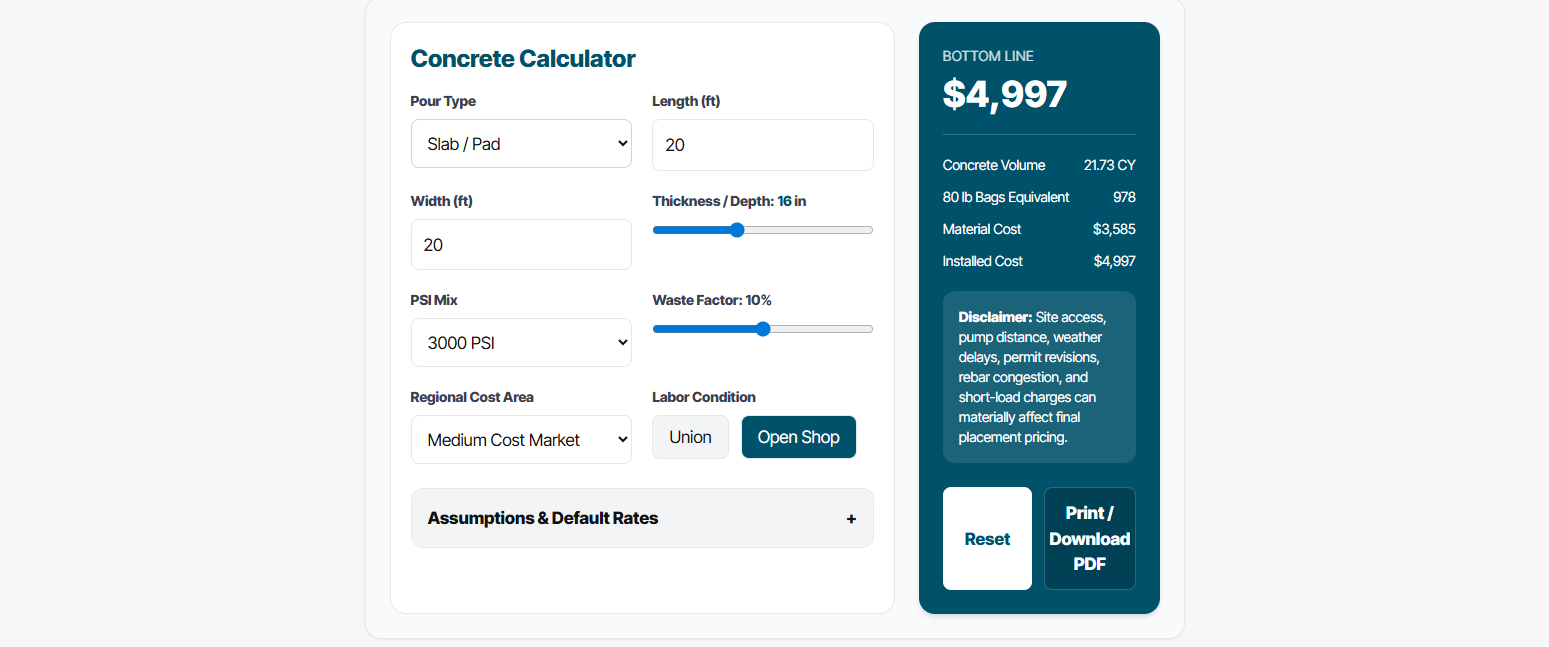
Concrete pricing rarely misses because of the mix—it misses on labor assumptions, mobilization, and poor take-offs. A driveway slab and a reinforced equipment pad may use similar yardage, but PSI requirements, placement difficulty, and crew burdened labor rates move the number fast. For smaller pours, short-load charges and pump access can swing installed cost more than the concrete itself.
National pricing in 2026 remains volatile depending on cement availability, diesel costs, and ready-mix capacity. Most estimators are carrying an added waste factor between 5%–15% depending on form complexity, over-excavation risk, and finish requirements. A standard broom finish at 4″ depth prices differently than a thicker slab with reinforcement congestion and higher PSI specifications.
This calculator uses national baseline labor assumptions ($40.92/hr burdened labor) and allows regional adjustment using a multiplier for rural, standard, or high-cost metro markets. Treat it as a bid-stage sanity check—not a substitute for supplier take-offs or vendor quotes.
Concrete Cost Calculator
National Average Pricing • 2026 Cost Basis
Burdened Labor: $40.92/hr national baseline
Concrete Material: $175/CY national average
Union Premium: +18%
Waste Allowance: 5–15%
PSI Premium: +8% (4000 PSI), +15% (5000 PSI)
Estimator Note:
Ready-mix pricing has shifted market-to-market in 2026 due to cement
supply constraints, fuel surcharges, and regional labor shortages.
Verify supplier quotes before locking bid numbers.
Bottom Line
Concrete Volume
80lb Bags Equivalent
Material Cost
Labor Cost
Installed Estimate
Field Disclaimer:
Mobilization fees, pump access, form complexity,
local inspections, permit delays, weather downtime,
and reinforcement congestion can materially affect final pricing.
The bottom line on concrete pricing is simple: small misses compound fast. A missed waste factor, wrong PSI assumption, or underestimated mobilization charge turns into margin loss before the truck leaves the batch plant. Treat this number as a preconstruction checkpoint, not your final procurement figure.
For bid work, pull at least three supplier quotes and compare short-load fees, environmental surcharges, and pump pricing. Metro markets are still seeing labor pressure in 2026, especially for finish crews and reinforced flatwork.
Before permit submission, cross-check local building codes for slab thickness, reinforcement schedules, frost depth, and compressive strength requirements. That review costs less than a failed inspection and a tear-out.
Last fact-checked and editorially reviewed on May 12, 2026.
How we created & reviewed this content:
The content in this article has been gone through our editorial process and currently reliable.
DISCLAIMER
Profound Estimates besides its services, also provides independent, fact-checked information about construction estimates and material takeoffs for general reference only and images on this site maybe AI-Assisted where appropriate and relevant. Read our full disclaimer for details. Read the disclaimer
INFORMATION SOURCES
Profound Estimates follows strict sourcing standards, relying only on credible, verifiable data from manufacturers, industry benchmarks, and reputable publications. Learn more about how we ensure content accuracy and transparency in our Editorial Policy. Editorial Policy
EDITORIAL HISTORY
Our team of writers, editors, and reviewers continually monitors the construction industry and updates articles when new information becomes available. See how we maintain transparency and editorial integrity in our Editorial Policy. Editorial Policy
Current version (May 12, 2026)
Technically reviewed by Amanda Ruiz.
Edited by Emily Carter.
DISCUSSION & FEEDBACK
We value reader insights and industry feedback to help us keep our content accurate and relevant. Learn how we handle reviews, corrections, and updates in our Editorial Policy. Editorial Policy
Leave a feedback on this post update at our social platforms.
CITE & SHARE
You’re welcome to cite and share profound estimates content for reference with proper attribution and a link back to the original article — helping more readers access trustworthy, well-researched construction information.