
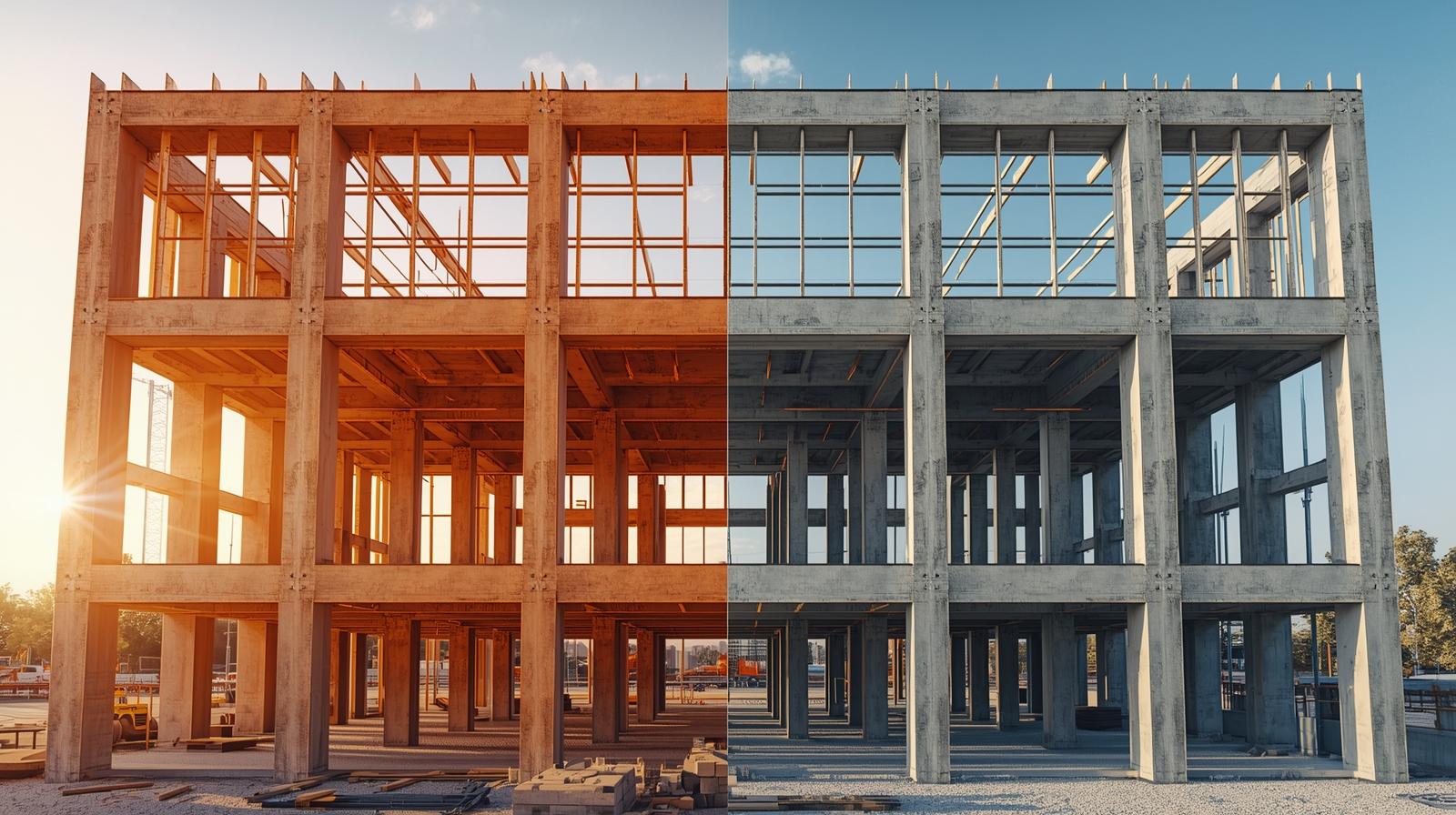
When planning a new building, one of the most critical cost decisions you’ll face is the choice of framing material — usually between concrete and steel.
Both materials offer unique advantages in terms of strength, design flexibility, and long-term performance. But when budgets are tight and timelines are strict, the real question becomes: which framing system delivers the best value for money?
In this guide, we’ll break down the cost comparison between concrete and steel framing — exploring not just material prices, but also labor, installation, maintenance, and long-term financial impact.
1. The Role of Framing in Construction Costs
Framing forms the structural backbone of any building. It supports loads, defines the building’s geometry, and influences nearly every other cost — from foundations to finishes.
Framing systems typically account for 15% to 25% of total construction costs. That means even small differences in material or labor efficiency can translate into major savings.
Choosing between concrete and steel isn’t just about upfront price; it’s about understanding how each system affects total project economics from start to finish.
2. Overview of Concrete and Steel Framing Systems
Concrete Framing
Concrete framing involves reinforced concrete columns, beams, and slabs. It’s widely used in commercial, residential, and industrial construction due to its strength and fire resistance.
Key characteristics:
- High mass and rigidity
- Excellent fire and thermal performance
- Long lifespan with low maintenance
- Heavier foundation requirements
Steel Framing
Steel framing consists of structural steel columns, beams, and girders assembled on-site or prefabricated off-site.
Key characteristics:
- Lightweight yet strong
- Quick installation
- Flexible design options
- High material precision and recyclability
Each system impacts cost differently depending on location, labor rates, project scale, and design complexity.
3. Initial Material and Fabrication Costs
Material pricing is the first — and often most visible — factor in comparing cost-effectiveness.
Concrete:
- Concrete itself is relatively inexpensive per cubic yard, but the reinforcement steel, formwork, and curing time add indirect costs.
- On average, reinforced concrete framing costs $90 to $130 per square foot for structural systems in commercial buildings.
- Custom formwork and complex geometries can push that higher.
Steel:
- Structural steel typically costs $100 to $160 per square foot installed, depending on market conditions and design.
- Fabrication costs can add up, but prefabrication and modular assembly help reduce on-site labor expenses.
✅ Verdict:
Concrete is generally cheaper on raw materials, but steel may reduce total cost when prefabrication efficiency and shorter schedules are considered.
4. Labor and Construction Speed
Time is money — and nowhere is that more evident than in framing.
Concrete:
- Requires skilled formwork carpenters, reinforcement installers, and curing time.
- Weather delays can significantly impact schedules.
- A mid-sized concrete structure can take 20–40% longer to complete than a comparable steel frame.
Steel:
- Prefabricated steel components arrive ready for assembly.
- Installation speed can be 30–50% faster than cast-in-place concrete.
- Less labor required on-site, reducing overhead and schedule risk.
✅ Verdict:
Steel wins in speed and labor efficiency — making it more cost-effective on tight schedules or labor-limited sites.
5. Structural Performance and Design Flexibility
The material’s structural efficiency affects long-term usability and cost.
Concrete:
- Offers excellent compressive strength, ideal for high loads and multi-story structures.
- Provides superior sound insulation and thermal mass, improving building comfort.
- However, design changes after casting are difficult and expensive.
Steel:
- Exceptional tensile strength allows for longer spans and lighter framing.
- Ideal for complex or modern designs requiring open spaces.
- Easier to modify or expand in the future.
✅ Verdict:
Steel provides greater design flexibility and adaptability, which can reduce costs in future renovations or expansions.
6. Maintenance and Lifecycle Costs
While upfront costs are important, long-term maintenance determines the true cost-effectiveness.
Concrete:
- Minimal maintenance once properly sealed and reinforced.
- Naturally resistant to rust, pests, and moisture damage.
- Repairs (e.g., cracking or spalling) can be costly but infrequent.
Steel:
- Requires regular protective coatings or galvanization to prevent corrosion.
- Susceptible to rust in coastal or humid environments without maintenance.
- However, easy to inspect and replace individual members.
✅ Verdict:
Concrete has the edge in maintenance savings, particularly for long-term ownership or low-maintenance designs.
7. Fire Resistance and Insurance Impact
Safety ratings influence insurance premiums and compliance costs.
- Concrete is naturally fire-resistant, often meeting code without additional treatment.
- Steel, while non-combustible, loses strength at high temperatures, requiring fireproofing sprays or coatings — adding 2–5% to total framing cost.
✅ Verdict:
Concrete offers superior fire resistance at no extra cost, while steel requires additional investment to meet fire code requirements.
8. Environmental and Sustainability Factors
Sustainability increasingly affects long-term project value and cost.
Concrete:
- Has a high carbon footprint due to cement production.
- Can integrate recycled aggregates but still contributes to CO₂ emissions.
- Offers high energy efficiency due to thermal mass.
Steel:
- 100% recyclable and often made from recycled scrap.
- Prefabrication reduces on-site waste.
- Energy-intensive production but efficient material reuse offsets impact.
✅ Verdict:
Steel has a sustainability advantage through recyclability, while concrete supports energy efficiency.
Sustainability certification goals (like LEED) often favor steel for environmental credits.
9. Total Cost of Ownership
To determine real cost-effectiveness, both short-term and long-term expenses must be analyzed.
| Category | Concrete Framing | Steel Framing |
|---|---|---|
| Material Cost | Lower | Moderate |
| Labor Cost | Higher | Lower |
| Construction Speed | Slower | Faster |
| Maintenance | Lower | Moderate |
| Flexibility | Limited | High |
| Fireproofing | Included | Added Cost |
| Sustainability | Medium | High |
| Design Changes | Costly | Easier |
✅ Overall Verdict:
- For short-term, fast-track projects, steel framing is often more cost-effective.
- For long-term, low-maintenance buildings, concrete framing provides better lifecycle value.
- The most cost-efficient choice depends on project type, climate, and future adaptability goals.
10. When to Choose Concrete vs. Steel
Choose Concrete If:
- The project demands high fire resistance or sound insulation.
- Long-term maintenance costs need to be minimal.
- Structural mass is beneficial (e.g., basements, foundations).
- The site has ample construction time.
Choose Steel If:
- The schedule is tight or labor is expensive.
- The design requires long spans or modern flexibility.
- The structure might be expanded or modified later.
- Environmental certifications are a priority.
Conclusion
Both concrete and steel are vital to modern construction — but cost-effectiveness isn’t just about the sticker price.
Concrete excels in durability and fire resistance, offering long-term stability with minimal upkeep. Steel, on the other hand, wins on flexibility, speed, and precision — saving valuable time and labor costs.
The smartest choice depends on your project’s priorities: if you’re optimizing for speed and adaptability, steel is the future. If you’re aiming for longevity and low maintenance, concrete remains unbeatable.
Understanding the trade-offs between these materials helps estimators, contractors, and clients make financially sound, data-driven decisions that define project success.