
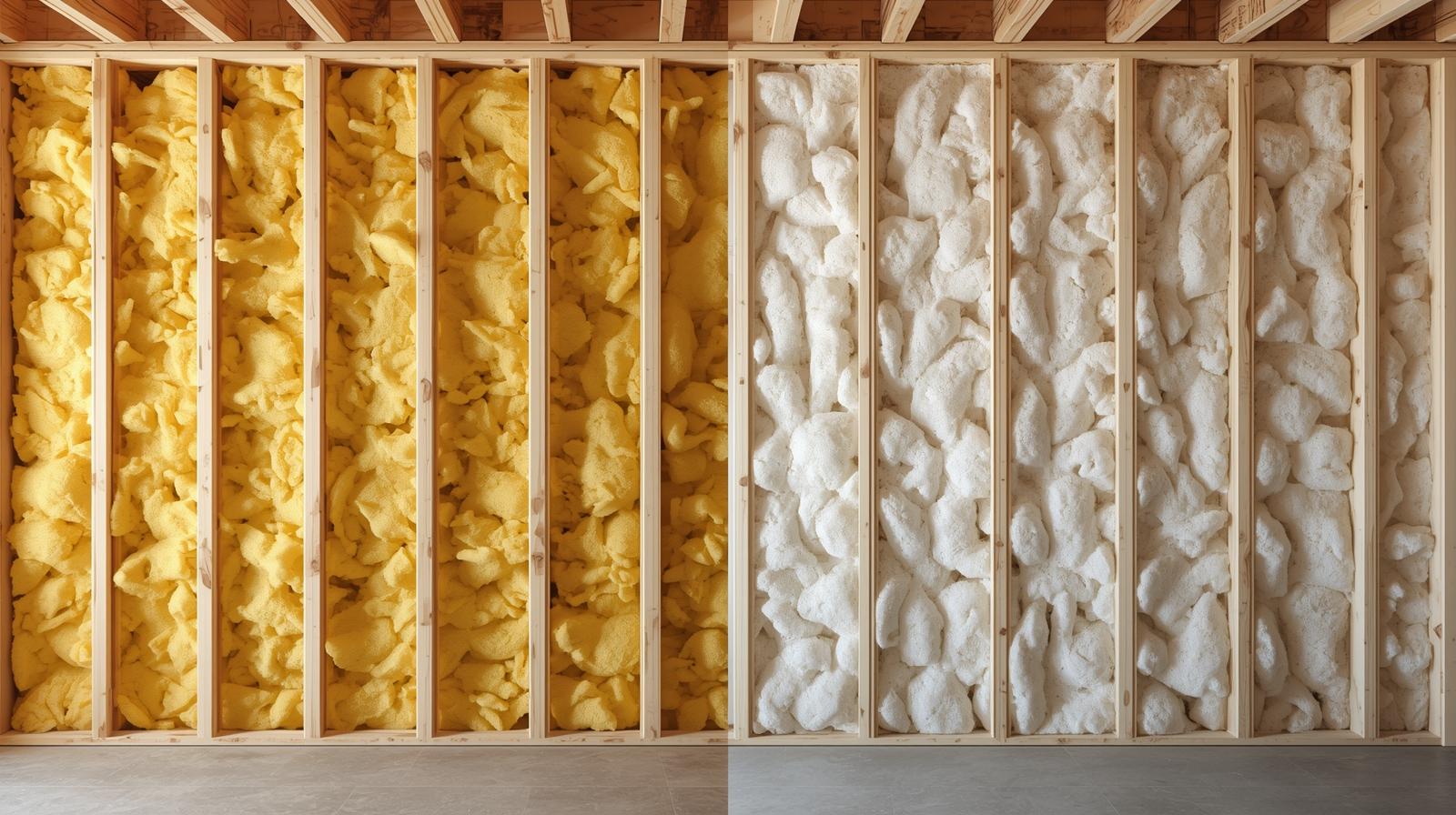
When insulating a home, two options dominate the market in the U.S: Spray Foam Insulation and Fiberglass Insulation. Both reduce energy loss, improve comfort, and impact long-term utility costs—but they differ significantly in price, lifespan, installation method, performance, and ROI.
This in-depth 2025 cost comparison breaks down everything you need to estimate correctly, budget smarter, and select the better insulation for your project.
1. Average Cost Comparison (National Estimates 2025)
| Insulation Type | Cost Per Sq Ft (Installed) | Cost Per 1,000 Sq Ft | R-Value Per Inch | Lifespan | Best Use Case |
|---|---|---|---|---|---|
| Fiberglass (Batts) | $1.10 – $2.00 | $1,100 – $2,000 | 2.2 – 2.7 | 20–30 yrs | Budget builds, attics, walls |
| Fiberglass (Blown-in) | $1.30 – $2.20 | $1,300 – $2,200 | 2.2 – 2.9 | 20–30 yrs | Attics, open cavities |
| Spray Foam (Open Cell) | $3.50 – $5.00 | $3,500 – $5,000 | 3.6 – 3.9 | 80+ yrs | Walls, soundproofing, air sealing |
| Spray Foam (Closed Cell) | $5.50 – $8.50 | $5,500 – $8,500 | 6.0 – 7.0 | 80+ yrs | Extreme climates, moisture resistance |
Quick summary:
- Fiberglass is 2–4x cheaper upfront.
- Spray foam performs 2–3x better in air sealing and durability.
2. Key Cost Drivers You Must Consider
| Cost Factor | Fiberglass Impact | Spray Foam Impact |
|---|---|---|
| Labor & Installation | Low, fast to install | High, skilled labor required |
| Equipment Cost | Minimal | Expensive spray rigs |
| Air Sealing Requirement | Needs separate sealing work | Includes air sealing automatically |
| Moisture Barrier | Often needs vapor barrier | Closed cell acts as its own barrier |
| Home Size & Cavity Depth | Minor impact | Cost increases heavily with thickness |
| Location & Climate | Cost varies slightly | Climate zone impacts foam type & depth |
3. Breakdown by Home Area
| Area | Fiberglass Cost | Spray Foam Cost | Recommended Option |
|---|---|---|---|
| Attic (1,000 SF) | $1,300 – $2,200 | $3,500 – $6,000 | Fiberglass (unless air sealing needed) |
| Walls (1,500 SF) | $1,650 – $3,000 | $5,500 – $10,000 | Spray Foam |
| Basement Rim Joists | $500 – $900 | $1,200 – $2,200 | Spray Foam |
| Crawl Space | $1,000 – $3,000 | $3,000 – $7,500 | Closed-cell Spray Foam |
4. Energy Savings & Long-Term ROI
| Insulation | Annual HVAC Cost Savings | Payback Time | 20-yr Total Savings |
|---|---|---|---|
| Fiberglass | 10–15% reduction | 5–7 yrs | $3,000 – $6,000 |
| Spray Foam | 25–45% reduction | 3–6 yrs | $8,000 – $16,000 |
Despite the higher upfront cost, spray foam often pays for itself faster due to reduced energy leakage and HVAC load.
5. Pros & Cons (Real-World Performance)
Fiberglass Insulation
Pros
- Most affordable option
- DIY-friendly
- Readily available nationwide
Cons
- Does not stop air leakage
- Can absorb moisture and mold
- Performance drops if compressed or poorly installed
Spray Foam Insulation
Pros
- Best air seal on the market
- Moisture resistant (closed cell)
- Strengthens wall structure
- Reduces outside noise
Cons
- Higher upfront cost
- Must be installed by a professional
- Installation odor requires temporary relocation
6. Regional Cost Differences
| Region | Fiberglass Avg | Spray Foam Avg |
|---|---|---|
| Northeast | $1.40 – $2.30 | $4.50 – $8.75 |
| Midwest | $1.20 – $2.00 | $4.00 – $7.80 |
| South | $1.00 – $1.90 | $3.80 – $7.50 |
| West Coast | $1.60 – $2.60 | $5.00 – $9.00 |
Spray foam costs spike in states with colder climates and stricter energy codes.
7. Code Requirements & R-Value Recommendations (2025)
| Climate Zone | Attic R-Value | Wall R-Value |
|---|---|---|
| 1–2 (Hot: FL, TX, LA) | R-30 to R-49 | R-13 to R-15 |
| 3–4 (Mild: CA, NC, TN) | R-38 to R-60 | R-13 to R-21 |
| 5–7 (Cold: NY, IL, MI) | R-49 to R-60 | R-21 to R-30 |
| 8 (Very Cold: AK) | R-60+ | R-30+ |
Closed-cell spray foam achieves high R-value faster and requires less thickness.
8. Hidden Costs Most People Miss
| Hidden Cost | Applies To | Estimated Cost |
|---|---|---|
| Air sealing before fiberglass | Fiberglass | $600–$2,000 |
| Vapor barrier installation | Fiberglass | $0.50–$1.50/sq ft |
| HVAC resizing due to better sealing | Spray Foam | $700–$2,500 |
| Temporary relocation during install | Spray Foam | $100–$400/day |
9. Which Option Should You Choose?
Choose Fiberglass when:
- Budget is tight
- No major air leaks present
- You only need thermal resistance, not air sealing
Choose Spray Foam when:
- You want maximum energy savings
- Moisture control is a priority
- You want air sealing + insulation in one step
- The home is in extreme climate conditions
10. ROI Recap: Best for Your Money?
| Priority | Best Option |
|---|---|
| Lowest budget | Fiberglass |
| Best energy savings | Spray Foam |
| Moisture protection | Closed-cell Spray Foam |
| DIY project | Fiberglass |
| Long lifespan | Spray Foam |
| Best soundproofing | Open-cell Spray Foam |
Final Verdict
If upfront cost is the only deciding factor, fiberglass wins.
If long-term savings, air sealing, durability, and performance matter more, spray foam wins in every measurable category.