
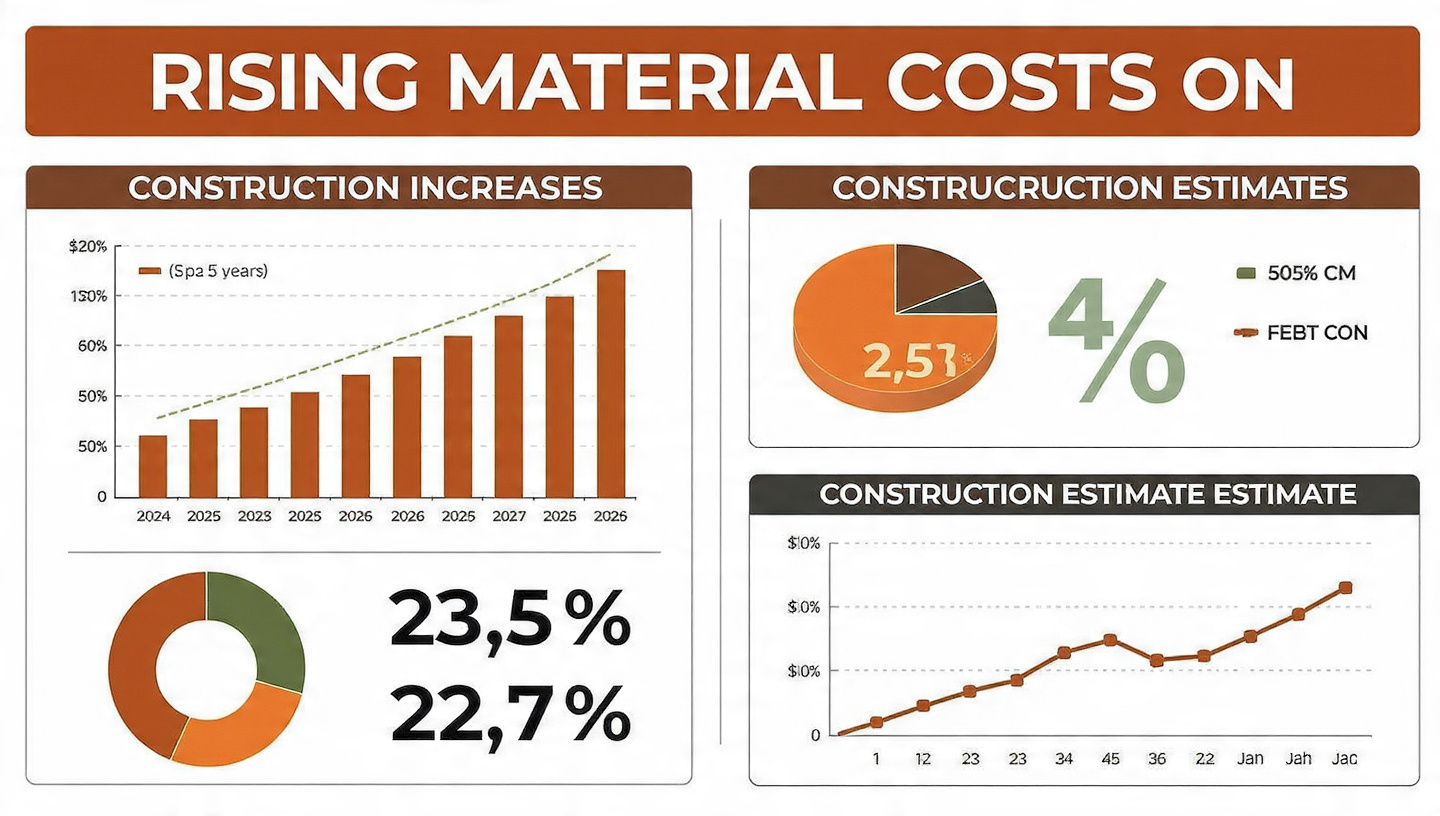
Construction estimating in the United States has always relied on predictable material prices, stable supply chains, and consistent market conditions. However, the post-pandemic economy and global trade disruptions have drastically altered this balance. From steel and concrete to lumber and electrical components, material costs in 2025 continue to fluctuate at levels unseen a decade ago — forcing contractors and estimators to rethink how they price projects and prepare bids.
This guide explores how rising material costs impact construction estimates, the data behind these increases, and actionable strategies for contractors to stay competitive while maintaining profitability.
1. Why Material Prices Are Rising in 2025
Several key factors are driving higher material costs across the construction industry:
| Factor | Description | Effect on Estimating |
|---|---|---|
| Supply Chain Disruptions | Ongoing delays in global shipping and shortages of key imports like steel and copper. | Leads to longer lead times and unpredictable price changes. |
| Inflation & Energy Costs | High fuel and energy prices directly raise the cost of production and delivery. | Increases baseline material costs and transportation expenses. |
| Labor Shortages | Manufacturing and logistics labor shortages in the U.S. increase production costs. | Adds indirect cost pressure on materials and availability. |
| High Demand for Infrastructure Projects | Federal and state infrastructure programs have spiked demand for materials. | Drives competition and price surges for core materials. |
| Climate Events & Regional Disruptions | Hurricanes, droughts, and extreme weather affect mining, production, and transport. | Causes temporary supply constraints and cost spikes. |
2. Materials Showing the Biggest Price Increases in 2025
Estimators need to monitor high-volatility materials closely to avoid cost overruns and uncompetitive bids.
| Material | Average Price Change (2024–2025) | Primary Cause |
|---|---|---|
| Steel Rebar & Structural Steel | +9% to +12% | Energy and raw material cost escalation |
| Concrete & Cement | +6% to +8% | Fuel, transportation, and aggregate shortages |
| Lumber & Plywood | +11% | Supply instability and housing demand |
| Electrical Copper Wire | +14% | Global copper supply deficit |
| PVC & Plumbing Materials | +8% | Petrochemical production slowdowns |
| Insulation & Roofing Materials | +7% | Oil price volatility and import costs |
Note: Percentages represent national averages from multiple regional datasets and estimating benchmarks (2025 industry averages).
3. How Rising Material Costs Affect Construction Estimates
a. Bid Competitiveness
Contractors struggle to stay competitive as fluctuating material costs make it difficult to lock in accurate bids. Underestimating costs leads to losses; overestimating makes bids uncompetitive.
b. Project Scheduling Risks
Volatile material prices force contractors to plan purchases strategically. Delays in procurement can lead to higher costs if prices rise before materials are ordered.
c. Cash Flow and Bonding
Higher material costs mean increased upfront capital requirements and bonding limits. This impacts cash flow and the ability to pursue multiple projects simultaneously.
d. Contract Negotiations
Estimators now play a more active role in negotiating escalation clauses — contract terms that adjust pricing if material costs rise beyond agreed thresholds.
4. Strategies to Manage Material Cost Volatility
| Strategy | How It Helps |
|---|---|
| Use Real-Time Cost Data Tools | Software like ProEst, STACK, or HeavyBid integrates live cost databases to update material prices instantly. |
| Add Escalation Clauses in Contracts | Protects contractors from losses due to price spikes during the project timeline. |
| Negotiate Bulk Purchases or Supplier Agreements | Locking prices in advance helps control future expenses. |
| Revisit Estimates Frequently | For long-term bids, revising estimates every 30-60 days ensures accuracy. |
| Value Engineering | Explore material alternatives that maintain performance but reduce cost exposure. |
| Collaborate Early with Suppliers | Building relationships helps gain insight into upcoming price changes. |
5. Regional Cost Trends Across the U.S.
Material price impact varies by region.
| Region | Key Material Pressure Points | Notes for Estimators |
|---|---|---|
| West Coast | Lumber, concrete, and rebar | High shipping costs and demand in urban centers |
| Midwest | Steel and cement | Energy and freight volatility |
| South | Roofing, PVC, and copper | Hurricane risk and rebuilding efforts |
| Northeast | Electrical materials and insulation | Labor and port congestion drive up costs |
6. Long-Term Outlook for 2025 and Beyond
Experts predict that material cost inflation will moderate slightly but remain higher than pre-pandemic levels. Trends shaping the next few years include:
- Increased use of AI-based cost forecasting and digital estimating tools.
- Greater reliance on regional suppliers to reduce transportation risks.
- Expansion of modular and prefabricated construction, reducing on-site material waste.
- Broader inclusion of escalation protection in contracts and bids.
Estimators who integrate technology, flexible pricing structures, and proactive sourcing will remain competitive even in uncertain conditions.
7. Key Takeaways for Estimators and Contractors
- Material cost volatility is the new normal in 2025.
- Regular updates to cost databases are essential for accurate estimates.
- Bid competitiveness depends on flexibility, not just low pricing.
- Escalation clauses and supplier partnerships are key risk-management tools.
- Contractors leveraging data-driven estimating tools will outperform manual processes.
Conclusion
Rising material costs are reshaping how construction estimates are prepared across the United States. Contractors who fail to adapt risk losing bids or profits. But with real-time data integration, supplier collaboration, and smart contract terms, estimators can maintain both accuracy and profitability — even in a volatile market.
Last fact-checked and editorially reviewed on October 28, 2025 .
How we created & reviewed this content:
The content in this article has been gone through our editorial process and currently reliable.
DISCLAIMER
Profound Estimates besides its services, also provides independent, fact-checked information about construction estimates and material takeoffs for general reference only and images on this site maybe AI-Assisted where appropriate and relevant. See our Disclaimer for details.
INFORMATION SOURCES
Profound Estimates follows strict sourcing standards, relying only on credible, verifiable data from manufacturers, industry benchmarks, and reputable publications. Learn more about how we ensure content accuracy and transparency in our Editorial Policy.
- U.S. Bureau of Labor Statistics – “Producer Price Index: Construction Materials 2025.”
- Associated General Contractors of America (AGC) – “Construction Inflation Alert 2025.”
- RSMeans Data – “Material Cost Trends 2024–2025.”
- Dodge Data & Analytics – “U.S. Construction Outlook 2025.”
- National Association of Home Builders (NAHB) – “Lumber and Material Market Reports.”
- American Institute of Steel Construction (AISC) – “Steel Cost Report 2025.”
- Portland Cement Association (PCA) – “Cement and Concrete Forecast.”
- U.S. Energy Information Administration (EIA) – “Fuel and Energy Price Impacts on Construction.”
- Construction Specifications Institute (CSI) – “Estimating Material Division Data.”
- ProEst Estimating Insights – “Material Price Management in Volatile Markets.”
- Turner Construction Cost Index – “National Trends Q3 2025.”
- Engineering News-Record (ENR) – “Construction Cost Report 2025.”
EDITORIAL HISTORY
Our team of writers, editors, and reviewers continually monitors the mobile industry and updates articles when new information becomes available. See how we maintain transparency and editorial integrity in our Editorial Policy.
- Current version
- Edited by Anthony Brooks
- October 28, 2025
- Written by Daniel Morales
- Edited by Anthony Brooks
- Editorially reviewed by Amanda Ruiz and Patricia Howard
DISCUSSION & FEEDBACK
We value reader insights and industry feedback to help us keep our content accurate and relevant. Learn how we handle reviews, corrections, and updates in our Editorial Policy.
- Leave a feedback on this post update at Reddit and Youtube.
CITE & SHARE IT
You’re welcome to cite and share profound estimates content for reference with proper attribution and a link back to the original article — helping more readers access trustworthy, well-researched construction information.