
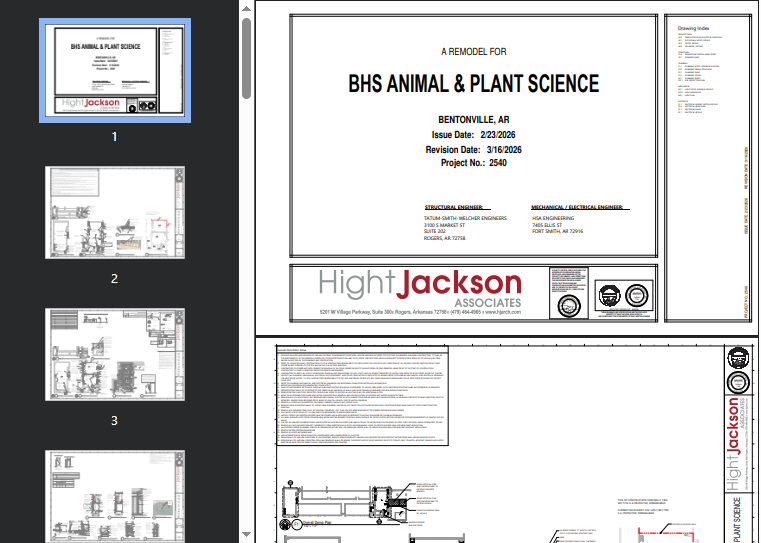
The BHS Animal & Plant Science Remodel is a single-story renovation project in Bentonville, Arkansas, involving interior upgrades and limited exterior utility modifications to support new plumbing fixtures, mechanical systems, and building openings.
The Earthwork & Wet Utilities scope is focused on localized excavation and underground utility work, not full site development. The work is primarily tied to:
- New sanitary sewer modifications
- Plumbing trench excavation and backfill
- Exterior tie-ins at building perimeter
- Minor grading and restoration
Relevant drawings include:
- P2.0 – Plumbing Demolition Plan
- P2.1 – Plumbing Plan
- S3.1 – Structural Notes (slab demo and trenching)
- A2.0 – Demolition Plan
- A2.1 – Floor Plan (utility penetration locations)
Structural notes confirm:
“Slab demo and pourback as required to remove and cap sanitary sewer lines.”
This indicates trenching and underground work tied directly to plumbing modifications.
2. TRADE ABSTRACT / SCOPE OVERVIEW
The Earthwork & Wet Utilities subcontractor scope includes:
A. Earthwork
- Sawcut and trench excavation (interior and exterior)
- Excavation for sanitary piping
- Subgrade preparation
- Backfill and compaction
- Fine grading and surface restoration
B. Wet Utilities Installation
- Sanitary sewer piping
- Vent piping below slab
- Cleanouts
- Pipe bedding
- Connections to existing system
C. Accessories
- Pipe fittings (wyes, tees, bends)
- Bedding sand
- Trench backfill material
- Warning tape
- Compaction materials
D. Labor & Equipment
- Excavation crew
- Compaction crew
- Pipe installation crew
- Equipment (mini-excavator, trenchers, compactors)
3. PLAN REVIEW PROCESS
Step 1 – Plumbing Sheets (P2.0 & P2.1)
Start with plumbing drawings to identify:
- New sanitary routing
- Pipe sizes
- Fixture connections
- Tie-in points
These determine trench lengths and pipe quantities.
Step 2 – Structural Coordination (S3.1)
Structural notes confirm trenching locations under slab and required restoration.
This defines excavation areas.
Step 3 – Architectural Floor Plan (A2.1)
Used to:
- Verify fixture locations
- Estimate pipe routing distances
- Identify exterior tie-ins
Step 4 – Demolition Plan (A2.0)
Confirms:
- Slab removal areas
- Existing piping removal zones
4. ESTIMATION PREPARATION STEPS
Assumptions
- Average trench width: 2’-0”
- Average trench depth: 3’-0”
- Soil assumed workable (no rock)
- Dewatering not required
- Existing utilities accessible for tie-in
- One mobilization
Waste Factors
- Pipe: 5%
- Bedding material: 10%
- Backfill: 10%
Labor Assumptions
Prevailing wage productivity:
- Trenching (machine): 25 LF/hr
- Pipe installation: 12 LF/hr
- Backfill/compaction: 30 LF/hr
Constructability Considerations
- Interior trenching reduces productivity
- Tight working areas
- Coordination with slab demolition
- Utility tie-in uncertainty
These increase labor costs significantly.
5. DETAILED MATERIAL TAKEOFF
A. Sanitary Sewer Piping
Assume based on fixture layout:
- Main line: 60 LF (4” pipe)
- Branch lines: 80 LF (3” pipe)
Total pipe:
140 LF
Waste @5%:
140 × 1.05 = 147 LF
B. Trench Excavation
Total trench length:
140 LF
Volume:
Width: 2’
Depth: 3’
140 × 2 × 3 = 840 CF = 31 CY
C. Bedding Material
Assume 6” bedding:
140 × 2 × 0.5 = 140 CF = 5.2 CY
Waste @10%:
5.2 × 1.10 = 5.7 CY
D. Backfill
Excavation minus pipe volume:
Approx. 25 CY compacted fill
Waste @10%:
28 CY
E. Fittings / Cleanouts
Assume:
- 6 fittings
- 2 cleanouts
6. LABOR & PRICING BUILD-UP (Prevailing Wage)
Material Pricing
Pipe:
147 LF × $18 = $2,646
Fittings:
6 × $85 = $510
Cleanouts:
2 × $150 = $300
Bedding:
5.7 CY × $65 = $371
Backfill:
28 CY × $45 = $1,260
Material Total:
$5,087
Labor Pricing
Excavation:
140 ÷ 25 = 5.6 hrs
5.6 × $65 = $364
Pipe Installation:
140 ÷ 12 = 11.7 hrs
11.7 × $72 = $842
Backfill/Compaction:
140 ÷ 30 = 4.7 hrs
4.7 × $65 = $306
Labor Total:
$1,512
Equipment
Mini-excavator, compactor, trench tools:
$1,250
Direct Cost
$5,087 + $1,512 + $1,250 = $7,849
O&P
Overhead 10%
$785
Profit 10%
$863
Tax (8% material)
$407
Final Earthwork & Wet Utilities Estimate:
$9,904
7. FINAL ESTIMATE SUMMARY
| Cost Item | Amount |
|---|---|
| Materials | $5,087 |
| Labor | $1,512 |
| Equipment | $1,250 |
| Tax | $407 |
| O&P | $1,648 |
| Final Estimate Total | $9,904 |
8. ESTIMATOR NOTES / PROFESSIONAL INSIGHTS
This scope is small in quantity but critical in sequencing, as it directly impacts plumbing, foundation restoration, and slab replacement.
Key cost drivers:
- Trenching under existing slab
- Utility tie-in complexity
- Backfill and compaction requirements
- Limited access conditions
- Coordination with plumbing and concrete trades
Even though only 140 LF of piping is installed, the cost reflects:
- Mobilization inefficiencies
- Interior excavation constraints
- Coordination risks
Key Risks:
- Unknown existing utility depth/location
- Potential conflicts with structural elements
- Soil variability
- Inspection delays
Recommended Bid Clarifications:
- Rock excavation excluded
- Dewatering excluded
- Existing utility locations assumed accurate
- Compaction testing by others
- One mobilization included