
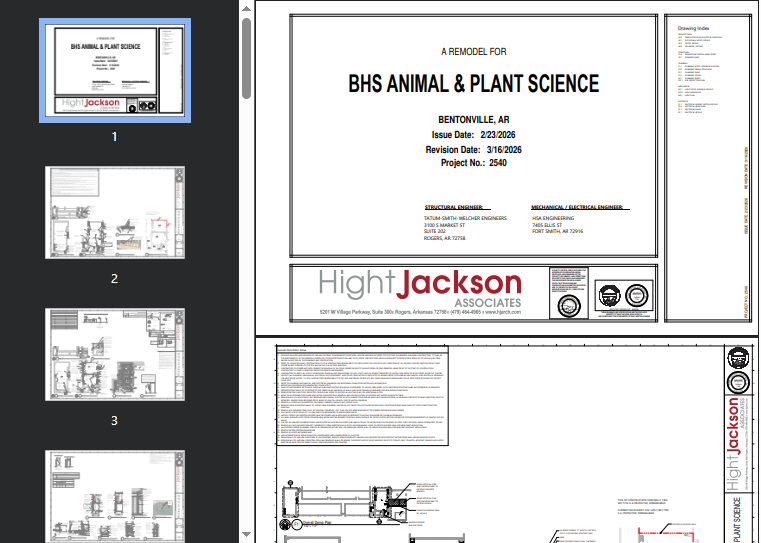
The BHS Animal & Plant Science Remodel is a single-story interior renovation project at an existing school facility in Bentonville, Arkansas, involving demolition and selective removal of architectural, mechanical, electrical, plumbing, and limited exterior components to accommodate the new renovation work.
The Site Preparation & Demolition scope includes all work necessary to safely prepare the project site, remove designated existing materials, protect adjacent occupied areas, and dispose of debris generated from interior demolition and selective exterior removals.
The relevant drawings for demolition scope include:
- A0.1 – General Notes / Project Information
- A2.0 – Demolition Plan and Demolition Notes
- A2.1 – Floor Plan
- M2.0 – HVAC Demolition Plan
- E2.0 – Electrical Demolition Plan
- P2.0 – Plumbing Demolition Plan
- S3.1 – Structural Coordination Notes
The demolition scope includes:
- Interior wall demolition
- Ceiling removal
- Floor finish demolition
- Selective concrete demolition
- Mechanical/electrical/plumbing demolition coordination
- Exterior selective demolition
- Debris hauling and disposal
- Protection and temporary barriers
This trade is highly labor-sensitive because the project is a selective remodel in an existing occupied educational facility, requiring careful demolition sequencing and protection of adjacent finishes.
2. TRADE ABSTRACT / SCOPE OVERVIEW
The demolition subcontractor scope includes:
A. Site Preparation
- Mobilization
- Dust barriers
- Temporary protection
- Floor protection
- Debris staging
- Safety barricades
Referenced in:
- A0.1 General Notes
- A2.0 Demo Notes
B. Interior Demolition
- Remove existing partitions
- Remove doors/frames as indicated
- Remove ceilings in renovation areas
- Remove floor finishes
- Remove casework
- Remove plumbing fixtures
- Remove MEP devices in demolition zones
Referenced in:
- A2.0 Demolition Notes
- M2.0
- E2.0
- P2.0
C. Exterior Selective Demolition
- Remove sidewalk at new exterior openings
- Remove masonry for new louver openings
- Remove slab at plumbing locations
Referenced in:
- A2.1
- S3.1
D. Hauling & Disposal
- Dumpster service
- Debris loading
- Disposal fees
- Final cleanup
E. Labor & Equipment
- Labor crews
- Demo saws
- Jackhammers
- Dump trailers
- Debris carts
3. PLAN REVIEW PROCESS
Step 1 – Review Architectural Demolition Plan (A2.0)
The estimator begins with A2.0, where demolition notes define:
- Walls to be removed
- Ceilings to be demolished
- Slab openings
- Door/frame removals
- Equipment removals
This is the main demolition quantity source.
Step 2 – Review MEP Demo Sheets
Then review:
- M2.0 HVAC Demo
- E2.0 Electrical Demo
- P2.0 Plumbing Demo
These identify:
- Existing duct removals
- Fixture removals
- Piping removals
- Device removals
These define coordinated demolition labor.
Step 3 – Review Structural Notes
Structural sheet S3.1 indicates slab demo and pour-back locations.
This identifies heavier demolition scope requiring sawcutting.
Step 4 – Review Architectural Floor Plan
A2.1 provides:
- New opening locations
- Exterior modifications
- Wall changes
These indicate selective exterior demolition quantities.
4. ESTIMATION PREPARATION STEPS
Before takeoff, the estimator sets assumptions:
Assumptions
- Interior demolition limited to renovation areas
- Adjacent occupied areas remain active
- Contractor responsible for debris disposal
- Hazardous material abatement excluded
- One mobilization assumed
Waste / Disposal Assumptions
- Demo debris loose load factor: 1.35
- Dumpster haul allowance: 20 CY
- Disposal included at local rates
Labor Assumptions
Prevailing wage demolition productivity:
- Wall demolition: 25 SF/hr
- Ceiling removal: 80 SF/hr
- Floor demo: 60 SF/hr
- Loading/cleanup: 6 CY/hr
Constructability Considerations
Selective demolition is slower because:
- Existing conditions vary
- Protection measures reduce productivity
- Occupied building logistics slow removal
- MEP coordination adds labor
These factors heavily influence labor cost.
5. DETAILED MATERIAL TAKEOFF
A. Interior Partition Demolition
Assume renovation area includes:
- 220 LF of partitions
- 10′ wall height
220 × 10 = 2,200 SF
Wall demolition productivity includes studs, drywall, and cleanup.
B. Ceiling Removal
Assume renovation area:
- 1,800 SF ACT ceiling removal
C. Floor Finish Removal
Assume:
- 1,800 SF flooring removal
Includes VCT/carpet demolition and scraping.
D. Doors / Frames Removal
Assume:
- 6 door/frame assemblies
E. Concrete Demolition
From slab patch areas:
- 120 SF slab demo
- 8 SF sidewalk removal
- 40 SF masonry opening removal
Total:
168 SF selective concrete/masonry demolition
F. Dumpster / Disposal
Loose debris estimate:
Walls:
2,200 SF × 0.15 CY = 330 CY
Ceiling:
1,800 SF × 0.03 CY = 54 CY
Flooring:
1,800 SF × 0.02 CY = 36 CY
Total loose debris:
420 CY
Compacted / hauled:
420 ÷ 20 = 21 dumpsters
6. LABOR & PRICING BUILD-UP (Prevailing Wage)
Using Arkansas prevailing demolition wage assumptions:
Labor Pricing
Partition Demolition:
2,200 ÷ 25 = 88 hrs
88 × $58 = $5,104
Ceiling Removal:
1,800 ÷ 80 = 22.5 hrs
22.5 × $58 = $1,305
Floor Demo:
1,800 ÷ 60 = 30 hrs
30 × $58 = $1,740
Doors/Frames:
6 × 2 hrs = 12 hrs
12 × $58 = $696
Concrete/Masonry Demo:
168 ÷ 15 = 11 hrs
11 × $58 = $638
Cleanup / Hauling:
21 × 2 hrs = 42 hrs
42 × $58 = $2,436
Labor Total:
$11,919
Equipment / Disposal
Dumpsters:
21 × $550 = $11,550
Demo tools / saws / carts:
Allowance = $950
Equipment Total:
$12,500
Materials / Protection
Dust barriers, poly, temporary protection:
$1,250
Direct Cost
$11,919 + $12,500 + $1,250 = $25,669
O&P
Overhead 10%
$2,567
Profit 10%
$2,824
Tax
Minimal taxable materials:
$100
Final Demo Estimate:
$31,160
7. FINAL ESTIMATE SUMMARY
| Cost Item | Amount |
|---|---|
| Materials / Protection | $1,250 |
| Labor | $11,919 |
| Equipment / Disposal | $12,500 |
| Tax | $100 |
| O&P | $5,391 |
| Final Estimate Total | $31,160 |
8. ESTIMATOR NOTES / PROFESSIONAL INSIGHTS
The demolition scope is labor-intensive and disposal-heavy, with dumpster hauling being one of the largest cost drivers.
Major pricing drivers:
- Occupied school environment
- Protection requirements
- Debris handling logistics
- Selective demolition coordination
- Concrete sawcut and patch locations
In selective remodel projects, demolition labor costs are often underestimated because the work requires:
- Careful removal around remaining finishes
- Controlled dust containment
- Segregated MEP demolition
- Frequent cleanup cycles
The disposal component alone represents over one-third of the estimate, which is typical for interior renovation demolition.
Recommended bid clarifications:
- Hazardous material abatement excluded
- Off-hours work excluded
- One mobilization included
- Salvage not included
- Structural demolition beyond plans excluded
These assumptions protect the subcontractor from concealed demolition risk.