
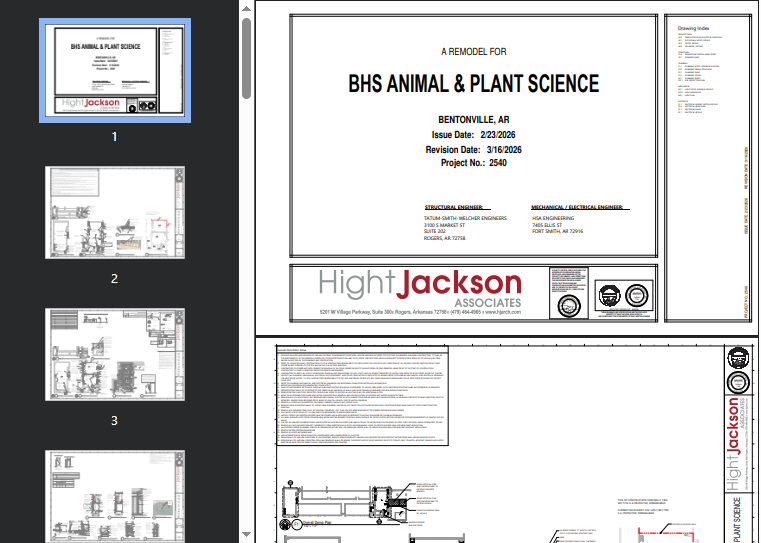
The BHS Animal & Plant Science Remodel is a single-story educational renovation project in Bentonville, Arkansas, consisting of the renovation of classrooms, office space, exam room, storage, shower room, and vestibule areas within an existing school facility.
The electrical scope includes demolition of existing electrical devices, new branch circuit wiring, lighting modifications, new devices, equipment connections, fire alarm relocations, and coordination with mechanical and architectural upgrades.
The primary plan sheets governing this scope are:
- E1.1 – Electrical Legend, Notes & Details
- E2.0 – Electrical Demo Plan
- E2.1 – Electrical Plans
- E3.1 – Electrical Details
- A2.1 – Architectural Floor Plan
- A2.0 – Demo Notes
These drawings indicate:
- Removal of existing electrical equipment in remodeled rooms
- New lighting fixtures and switching
- Receptacles and dedicated outlets
- Mechanical equipment electrical connections
- Fire alarm device relocation
- Low-voltage demolition coordination
This is a complete electrical remodel package, requiring full coordination with architectural, HVAC, and plumbing systems.
2. TRADE ABSTRACT / SCOPE OVERVIEW
The complete electrical subcontract scope includes:
A. Electrical Demolition
- Remove existing lighting in remodeled ceiling areas
- Remove devices in demolished walls
- Remove surface raceways
- Remove card reader/keypad devices
- Demo coaxial and data lines
- Relocate fire alarm strobes
Referenced on:
- A2.0 Demo Notes
- E2.0 Electrical Demo Plan
Architectural demolition notes specifically call for:
- “Remove existing lights”
- “Remove card reader, keypad, and associated access control hardware”
- “Demo coaxial cables”
- “Relocate ceiling mount strobe”
B. New Electrical Installation
- New branch circuits
- New LED lighting fixtures
- New switches
- New receptacles
- Dedicated outlets for equipment
- Power for HVAC equipment
- Emergency fixtures
- Fire alarm device reconnections
Referenced on:
- E2.1 Electrical Plan
- A2.1 Reflected Ceiling Plan
C. Accessories
- Boxes
- Conduit
- MC cable
- Disconnects
- Device plates
- Supports
- Fire stopping
D. Labor Considerations
- Demo labor
- Rough-in labor
- Device trim-out
- Testing and startup
E. Equipment Considerations
- Scissor lift
- Testing equipment
- Core drilling tools
- Temporary power
3. PLAN REVIEW PROCESS
Step 1 – Review Electrical Notes & Legend (E1.1)
Start with E1.1 to confirm:
- Device symbols
- Wiring methods
- Fixture types
- Installation standards
This sheet establishes the basis of electrical takeoff.
Step 2 – Review Demo Plan (E2.0)
Identify:
- Removed devices
- Lighting removals
- Fire alarm relocations
- Low-voltage removals
This establishes demolition labor requirements.
Step 3 – Review Electrical Plan (E2.1)
Determine:
- New fixture counts
- Device counts
- Circuit routing
- Dedicated power connections
This forms the material takeoff basis.
Step 4 – Review Architectural Ceiling Plan (A2.1)
Architectural notes indicate:
- “Provide new LED lights & diffusers”
- “New light to replace existing in soffit”
This confirms fixture quantities.
Step 5 – Coordinate with Mechanical
Electrical estimator reviews HVAC sheets for:
- Exhaust fan power
- Mechanical equipment connections
- Controls wiring
This coordination prevents scope gaps.
4. ESTIMATION PREPARATION STEPS
Before takeoff, assumptions are defined:
Assumptions
- Existing panel capacity is adequate
- Existing homeruns can be extended
- EMT/MC in concealed spaces
- Standard LED fixture package
- Fire alarm by electrical subcontractor
Waste Factors
- Wire: 10%
- Conduit: 10%
- Devices: 5%
- Fixtures: 3%
Labor Assumptions
Prevailing wage electrical labor productivity:
- Lighting fixture install: 1.5 hrs/fixture
- Receptacle/switch: 1 hr/device
- Circuit rough-in: 0.12 hrs/LF
- FA relocation: 2 hrs/device
Constructability Considerations
Electrical renovation labor is impacted by:
- Existing conditions uncertainty
- Ceiling access restrictions
- Coordination with ceiling replacement
- Existing circuit tracing
These factors increase labor costs substantially.
5. DETAILED MATERIAL TAKEOFF
A. LED Lighting Fixtures
From reflected ceiling plan:
Assume:
- 8 new LED fixtures
- 2 replacement soffit fixtures
Total:
10 fixtures
B. Switches / Receptacles
Assume remodeled rooms receive:
- 12 duplex receptacles
- 6 switches
Total:
18 devices
C. Fire Alarm Relocation
Architectural note:
- 1 ceiling-mounted strobe relocation
Total:
1 device
D. HVAC Equipment Connections
Assume:
- 1 exhaust fan
- 2 louver/control related terminations
Total:
3 connections
E. Branch Circuit Wiring
Assume:
- Average 60 LF per fixture/device circuit
- 31 total terminations
31 × 60 = 1,860 LF
Waste @10%:
2,046 LF
F. Conduit
Assume:
- 65% of branch wiring in conduit
2,046 × 65% = 1,330 LF
6. LABOR & PRICING BUILD-UP (Prevailing Wage)
Using Arkansas prevailing wage assumptions:
Material Pricing
Fixtures:
10 × $185 = $1,850
Devices:
18 × $45 = $810
Fire Alarm:
1 × $180 = $180
Equipment Connections:
3 × $90 = $270
Wire:
2,046 LF × $0.55 = $1,125
Conduit:
1,330 LF × $1.35 = $1,796
Boxes / plates / misc:
Allowance = $650
Material Total:
$6,681
Labor Pricing
Lighting Fixtures:
10 × 1.5 = 15 hrs
15 × $82 = $1,230
Devices:
18 × 1 hr = 18 hrs
18 × $82 = $1,476
Wiring Rough-In:
2,046 × 0.12 = 246 hrs
246 × $82 = $20,172
Fire Alarm:
2 hrs × $82 = $164
Equipment Connections:
6 hrs × $82 = $492
Labor Total:
$23,534
Equipment
Lift rental, testing, tools:
$850
Direct Cost
$6,681 + $23,534 + $850 = $31,065
O&P
Overhead 10%
$3,106
Profit 10%
$3,417
Tax (8% on material)
$535
Final Electrical Estimate:
$38,123
7. FINAL ESTIMATE SUMMARY
| Cost Item | Amount |
|---|---|
| Materials | $6,681 |
| Labor | $23,534 |
| Equipment | $850 |
| Tax | $535 |
| O&P | $6,523 |
| Final Estimate Total | $38,123 |
8. ESTIMATOR NOTES / PROFESSIONAL INSIGHTS
The electrical scope is the largest coordination trade in this renovation, driven more by labor intensity than by material value.
The key cost drivers are:
- Existing circuit tracing
- Ceiling access limitations
- Device relocation coordination
- Mechanical equipment tie-ins
- Fire alarm modifications
In renovation projects, electrical labor productivity drops sharply due to:
- Unknown existing conduit paths
- Live building conditions
- Demolition coordination
- Existing panel access constraints
The rough-in labor cost dominates the estimate, which is typical for remodel projects.
Recommended bid clarifications:
- Existing panel capacity by others
- No switchgear upgrades included
- No after-hours work included
- Existing fire alarm panel compatible
- Ceiling access available during working hours
These assumptions protect the subcontractor against concealed-condition risk.