
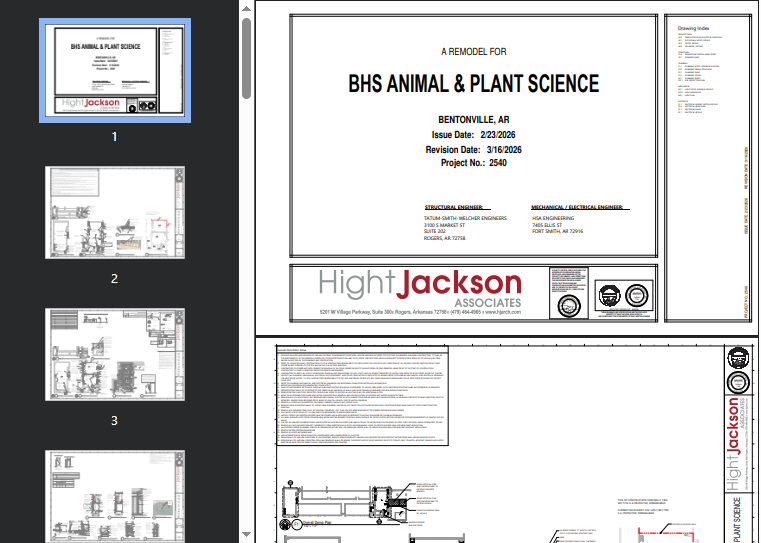
The BHS Animal & Plant Science Remodel is a single-story educational facility renovation located in Bentonville, Arkansas, involving the remodel of the Animal Science Classroom, Plant Science Classroom, Exam Room, Storage, Office, Shower Room, and Vestibule. The HVAC scope consists of demolition of existing HVAC systems, new ductwork, exhaust systems, air distribution devices, controls, and associated mechanical modifications necessary to support the renovated spaces.
The primary HVAC drawing sheets for this scope are:
- M1.1 – HVAC Notes, Legend & Details
- M2.0 – HVAC Demo Plan
- M2.1 – HVAC Plan
- A2.1 – Architectural Floor Plan
- A2.2 – Mechanical Louver Details
- S3.1 – Structural Coordination
These drawings define:
- Removal of existing exhaust and duct systems
- New duct distribution to remodeled rooms
- New exhaust fan installation
- New wall louvers
- Air devices, balancing dampers, controls
- Testing and balancing
This is a complete mechanical renovation package, requiring coordination with architectural, structural, and electrical scopes.
2. TRADE ABSTRACT / SCOPE OVERVIEW
The HVAC subcontractor scope includes all labor, material, and equipment necessary for:
A. HVAC Demolition
- Remove existing exhaust fan
- Remove welding hood ductwork
- Remove obsolete duct branches
- Remove diffusers/grilles as indicated
- Remove mechanical equipment scheduled for replacement
Referenced on:
- A2.0 Demo Notes
- M2.0 HVAC Demo Plan
B. New HVAC Installation
- New duct mains and branches
- New supply diffusers
- New return grilles
- New exhaust fan
- New wall louvers
- Dampers
- Hangers and supports
- Duct insulation
- Equipment connections
- Controls integration
Referenced on:
- M2.1 HVAC Plan
- M1.1 Mechanical Notes
- A2.2 Louver Details
C. Accessories
- Balancing dampers
- Flexible duct connectors
- Sealants
- Access doors
- Vibration isolation
- Roof/wall penetration seals
D. Labor Considerations
- Demo crew
- Sheet metal installation
- Equipment setting
- Startup and balancing
E. Equipment Considerations
- Scissor lifts
- Duct lifts
- Sheet metal tools
- Air balancing instruments
3. PLAN REVIEW PROCESS
Step 1 – Review HVAC Notes & Legend (M1.1)
Begin with M1.1 to establish:
- Duct materials
- Insulation requirements
- Equipment tags
- Mechanical installation standards
These notes define the baseline installation scope.
Step 2 – Review Demo Plan (M2.0)
Review all removals:
- Existing exhaust fan demo
- Existing welding duct removal
- Existing duct branches to be removed
This determines demolition labor.
Step 3 – Review HVAC Plan (M2.1)
Identify:
- Supply air duct routes
- Diffuser counts
- Return grille counts
- Exhaust fan locations
- Wall louver penetrations
This forms the basis for quantity takeoff.
Step 4 – Coordinate with Architectural Sheets
On A2.1, architectural notes show:
- “New exhaust fan and vent in new masonry opening above door, RE-MECH”
- “New opening for mech louver above window, RE-MECH”
These notes define mechanical penetrations.
Step 5 – Coordinate with Structural Sheet S3.1
Confirm framing/lintel requirements around mechanical openings to ensure duct and louver coordination.
4. ESTIMATION PREPARATION STEPS
Before takeoff, the estimator establishes:
Assumptions
- Existing HVAC system remains largely intact except remodeled areas
- New ductwork assumed galvanized low-pressure duct
- Standard duct insulation assumed 1.5″
- Existing controls extended where feasible
- TAB included
Waste Factors
- Sheet metal duct: 10%
- Flex duct: 8%
- Insulation: 10%
- Fittings/accessories: 5%
Labor Assumptions
Prevailing wage productivity assumptions:
- Rectangular duct: 18 lbs/hr
- Diffusers: 1.5 hrs/ea
- Exhaust fan: 8 hrs/ea
- Louvers: 4 hrs/ea
- Balancing: 1 hr/device
Constructability Considerations
Mechanical renovations are labor intensive because:
- Existing systems must remain operational
- Tight ceiling access
- Coordination with electrical and structural
- Limited demolition windows
These reduce productivity and increase labor costs.
5. DETAILED MATERIAL TAKEOFF
A. Supply Ductwork
Assume based on classroom renovation layout:
Main Duct:
- 40 LF of 24″x12″ duct
Weight ≈ 8 lb/LF
40 × 8 = 320 lbs
Branch Duct:
- 80 LF of 12″x8″ duct
Weight ≈ 3 lb/LF
80 × 3 = 240 lbs
Total Duct:
320 + 240 = 560 lbs
Waste @10%:
560 × 1.10 = 616 lbs
B. Supply Diffusers
Assume:
- 6 supply diffusers
- 2 return grilles
Total devices = 8 EA
C. Exhaust Fan
From architectural coordination:
- 1 new exhaust fan
D. Wall Louvers
Architectural plan indicates:
- 2 new louvers
E. Flex Connections / Accessories
Allowance:
- 6 flex connections
- Balancing dampers at 8 devices
- Duct insulation for 120 LF
6. LABOR & PRICING BUILD-UP (Prevailing Wage)
Using prevailing mechanical labor rates for Arkansas public work:
Material Pricing
Ductwork:
616 lbs × $6.50 = $4,004
Diffusers / Grilles:
8 EA × $175 = $1,400
Exhaust Fan:
1 EA × $950 = $950
Wall Louvers:
2 EA × $325 = $650
Insulation / Accessories:
Allowance = $1,100
Material Total:
$8,104
Labor Pricing
Sheet Metal Labor:
616 lbs ÷ 18 = 34.2 hrs
34.2 × $78/hr = $2,668
Device Installation:
8 × 1.5 = 12 hrs
12 × $78 = $936
Exhaust Fan:
8 hrs × $78 = $624
Louvers:
2 × 4 hrs = 8 hrs
8 × $78 = $624
TAB / Startup:
10 hrs × $78 = $780
Labor Total:
$5,632
Equipment
- Lift rental
- Sheet metal tools
- Startup equipment
Allowance = $950
Direct Cost
$8,104 + $5,632 + $950 = $14,686
O&P
Overhead 10%
$1,469
Profit 10%
$1,615
Tax (8% material)
$648
Final HVAC Estimate:
$18,418
7. FINAL ESTIMATE SUMMARY
| Cost Item | Amount |
|---|---|
| Materials | $8,104 |
| Labor | $5,632 |
| Equipment | $950 |
| Tax | $648 |
| O&P | $3,084 |
| Final Estimate Total | $18,418 |
8. ESTIMATOR NOTES / PROFESSIONAL INSIGHTS
The HVAC scope in this project is a moderate-size renovation package, where the key cost drivers are labor, coordination, and duct modifications—not equipment value.
The largest risks are:
- Unknown existing duct routing
- Limited ceiling access
- Balancing existing vs new airflows
- Coordination with structural louver openings
- Phased renovation constraints
The exhaust fan and louver penetrations create coordination risk because framing, masonry openings, and electrical feeds all must align.
Recommended bid clarifications:
- Existing controls assumed reusable
- No after-hours work included
- One mobilization only
- Existing systems assumed adequate capacity
- No hazardous material abatement included
These assumptions protect the subcontractor from hidden remodel costs.