
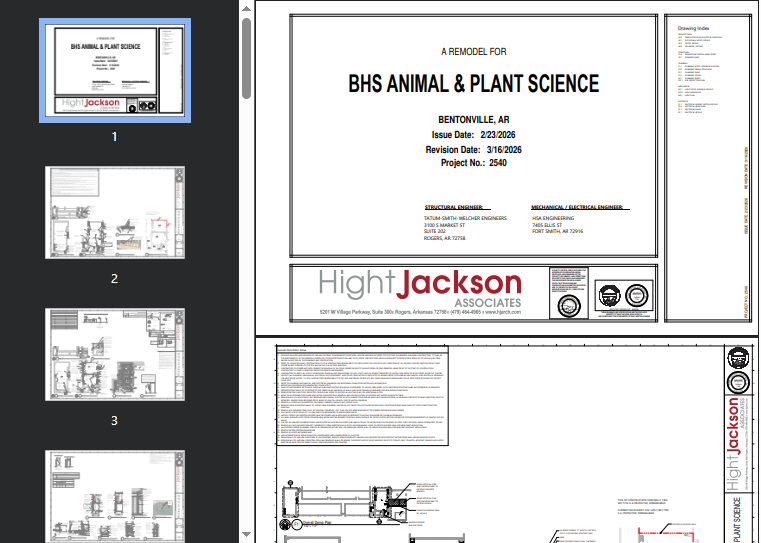
The BHS Animal & Plant Science Remodel is a single-story renovation project involving interior remodeling and limited exterior envelope modifications at an existing school facility in Bentonville, Arkansas. The roofing scope for this project is not a full reroof but rather localized roofing demolition, patching, penetration flashing, and weatherproofing work associated with new mechanical penetrations and exterior wall modifications.
The roofing-related work is identified in the following sheets:
- A2.1 – Floor Plan, Notes, Details
- A2.2 – Architectural Details
- M2.1 – HVAC Plan
- M1.1 – HVAC Notes / Details
- S3.1 – Framing Plan
- Architectural wall penetration details for new louvers and flashings
These sheets indicate:
- New wall louver penetrations
- Roof/weatherproof flashing modifications
- Exterior waterproofing patch work
- Sealant and flashing at penetrations
- Roofing-related coordination with mechanical penetrations
While the project does not indicate a full roof replacement, the roofing subcontractor’s scope is critical because all new penetrations through the building envelope require waterproof integrity restoration, including flashing, sealants, coping modifications, and roofing membrane tie-ins.
2. TRADE ABSTRACT / SCOPE OVERVIEW
The complete roofing subcontractor scope includes:
A. Roofing Demolition
- Remove roofing as required around new penetrations
- Cut and patch membrane/roof insulation where penetrations occur
- Remove flashing where wall penetrations affect roofing intersections
Referenced in:
- Mechanical penetration notes
- Louver penetration details on A2.2 D5 and D8
B. New Roofing Work
- Roofing membrane patching
- Flashing installation at penetrations
- Counterflashing/sealant
- Roof curb flashing
- Waterproof tie-ins to existing roof system
C. Accessories
- Sheet metal flashings
- Termination bars
- Sealants
- Fasteners
- Insulation patching
D. Labor & Equipment
- Roof access setup
- Material hoisting
- Hot-air welding / membrane patching
- Sealant application
- Waterproof inspection
3. PLAN REVIEW PROCESS
For roofing estimating, the estimator reviews the project in this sequence:
Step 1 – Architectural Exterior Penetration Details
Start with A2.2 D5 and D8, which show:
- New mechanical louver penetrations
- New flashing at penetrations
- Sealant around louver
- Prefinished metal thru-wall flashing
These details define waterproofing requirements.
Step 2 – Floor Plan / Exterior Openings
Review A2.1, which identifies:
- “New opening for mech louver above window”
- “New exhaust fan and vent in new masonry opening above door”
These notes identify the quantity of penetrations.
Step 3 – Mechanical Sheets
Review M2.1 to identify:
- Duct curb penetrations
- Exhaust penetrations
- Roof tie-ins
These sheets quantify the roofing penetrations.
Step 4 – Structural Coordination
Review S3.1 for framing impacts around penetrations to determine flashing interface requirements.
4. ESTIMATION PREPARATION STEPS
Before takeoff, the estimator defines:
Assumptions
- Existing roof system assumed single-ply membrane
- Roofing penetrations assumed small mechanical penetrations
- No full reroof included
- Roofing contractor responsible for watertight patching only
Waste Factors
- Membrane: 10%
- Flashing: 8%
- Sealants: 5%
Labor Assumptions
Roof patch work has low productivity due to mobilization:
- Small membrane patching: 25 SF/hr
- Flashing: 8 LF/hr
- Sealant: 20 LF/hr
Constructability Considerations
Small roofing repair scopes are labor-heavy due to:
- Mobilization to roof for minimal work
- Tie-in to existing membrane
- Weather constraints
- Leak liability
These increase installed unit cost significantly.
5. DETAILED MATERIAL TAKEOFF
A. Louver / Vent Penetration Flashing
From A2.1:
- Two new louver penetrations
- One exhaust vent penetration
Assume average curb perimeter:
Louver curb:
2 EA × 8 LF = 16 LF
Exhaust penetration:
1 EA × 6 LF = 6 LF
Total flashing:
22 LF
Waste @8%:
22 × 1.08 = 24 LF
B. Roofing Membrane Patching
Assume:
- 3 penetrations × 25 SF patch area = 75 SF
Waste @10%:
75 × 1.10 = 83 SF
C. Sealant
Perimeter sealant:
24 LF flashing + 24 LF counterflashing = 48 LF
Waste @5%:
48 × 1.05 = 50 LF
D. Insulation Replacement
Assume:
- 75 SF membrane patch area
- 1 layer ISO board
Waste @10%:
75 × 1.10 = 83 SF
Total Quantities
| Item | Qty |
|---|---|
| Membrane Patching | 83 SF |
| Flashing | 24 LF |
| Sealant | 50 LF |
| ISO Insulation | 83 SF |
6. LABOR & PRICING BUILD-UP (Prevailing Wage)
Assuming prevailing roofing labor rates in Arkansas:
Material Pricing
Membrane patching:
83 SF × $4.50 = $374
Flashing:
24 LF × $8.50 = $204
Sealant:
50 LF × $2.25 = $113
Insulation:
83 SF × $2.80 = $232
Fasteners / misc:
Allowance = $150
Material Total:
$1,073
Labor Pricing
Roofing mechanic:
24 hrs × $68/hr = $1,632
Laborer:
16 hrs × $42/hr = $672
Labor Total:
$2,304
Equipment
Roof access, fall protection, tools:
$550
Direct Cost
$1,073 + $2,304 + $550 = $3,927
Overhead & Profit
Overhead 10%
$393
Profit 10%
$432
Tax (8% on material)
$86
Final Roofing Estimate:
$4,838
7. FINAL ESTIMATE SUMMARY
| Cost Item | Amount |
|---|---|
| Materials | $1,073 |
| Labor | $2,304 |
| Equipment | $550 |
| Tax | $86 |
| O&P | $825 |
| Final Estimate Total | $4,838 |
8. ESTIMATOR NOTES / PROFESSIONAL INSIGHTS
The roofing scope is small in material volume but high in risk exposure, because the contractor assumes responsibility for maintaining the building envelope watertightness.
The primary cost drivers are:
- Mobilization for small quantities
- Weatherproofing liability
- Tie-in complexity to existing roof
- Coordination with mechanical penetrations
Even though less than 100 SF of membrane is required, the installed roofing repair cost remains high due to mobilization, access, and warranty risk.
Key bid clarifications:
- Assume existing roofing is patchable
- No hazardous material abatement included
- No concealed deck replacement included
- Roofing warranty limited to repair areas only
- One mobilization only
These clarifications are essential for avoiding post-award disputes.