
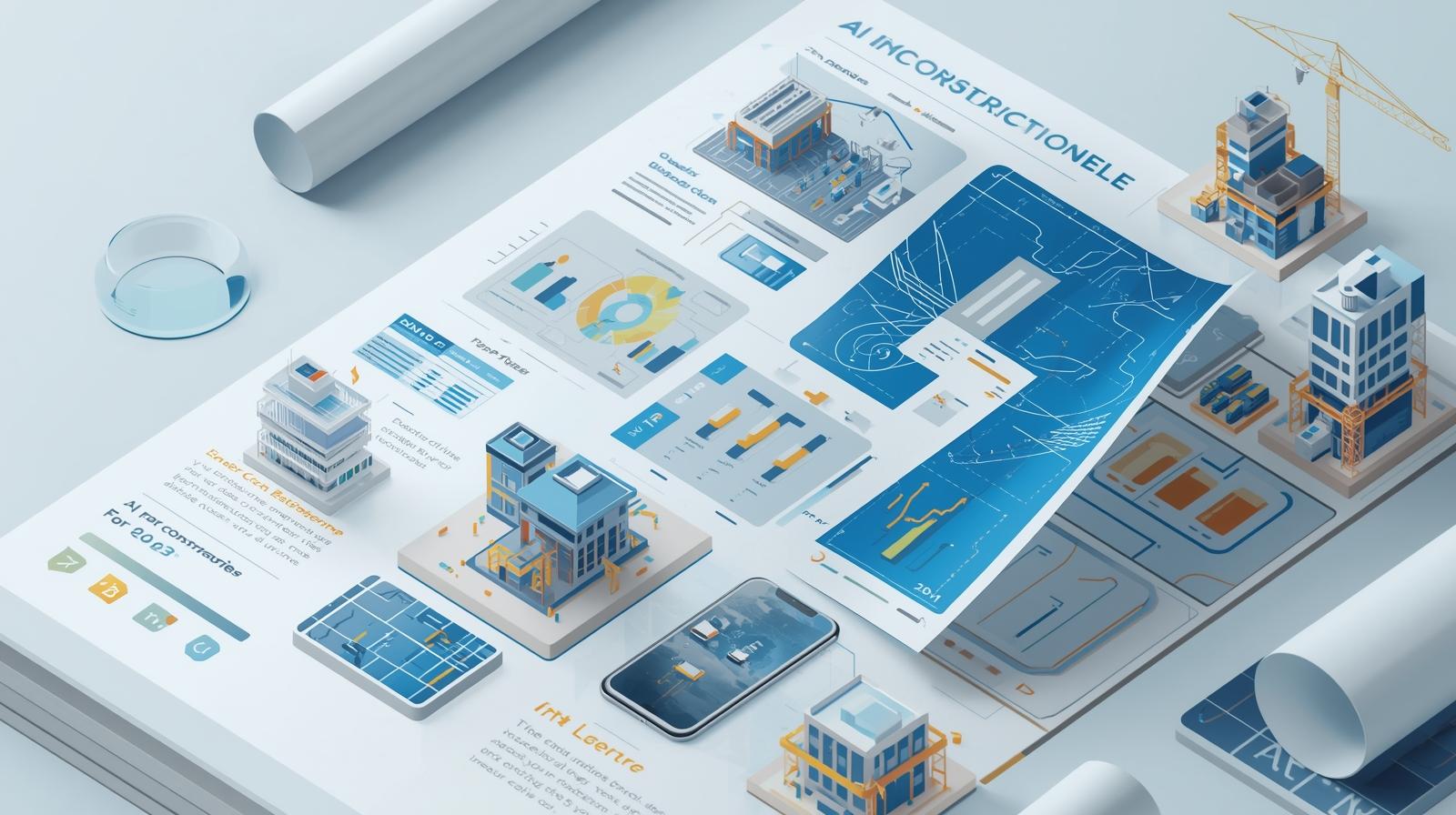
Construction estimating has evolved far beyond manual spreadsheets and isolated software tools. The new frontier is Artificial Intelligence (AI) — a technology reshaping how contractors, estimators, and project managers approach cost prediction, risk analysis, and resource allocation.
In 2025, AI is no longer experimental in construction. It’s practical, affordable, and incredibly effective at turning project data into reliable cost insights. This guide will explain how to use AI in construction estimation, step by step — covering what it does, how it works, tools you can adopt, and best practices for accurate, data-driven cost forecasting.
1. What Is AI in Construction Estimation?
AI in construction estimation refers to the use of machine learning, predictive analytics, and automation to analyze project data and generate precise cost estimates.
Unlike traditional estimating methods that rely heavily on manual data entry, AI systems learn from:
- Historical project records
- Market trends
- Material price databases
- Labor productivity data
- Equipment usage and logistics
They use this knowledge to predict costs, spot anomalies, and suggest optimal pricing strategies.
In simple terms, AI estimating tools think like an experienced estimator — but faster and without human fatigue.
2. Why Use AI for Construction Estimating
Accuracy
AI algorithms can analyze thousands of cost variables and past project outcomes to detect pricing errors, inconsistencies, or hidden cost drivers that humans might overlook.
Speed
AI-driven tools generate estimates in minutes rather than hours or days, allowing estimators to respond faster to bid opportunities.
Consistency
AI removes human bias and ensures every estimate follows the same data-driven logic.
Predictive Power
AI doesn’t just tell you what a project might cost today — it forecasts what it could cost next month or next quarter, based on trends in materials, labor, and inflation.
Integration
Modern AI estimating systems connect with Building Information Modeling (BIM), scheduling tools, and accounting systems, creating a seamless flow from design to budgeting to execution.
3. How AI Works in Estimation
AI systems in construction estimation rely on three main technologies:
a. Machine Learning (ML)
Machine learning algorithms analyze past projects to identify relationships between design parameters and final costs.
Example: If a contractor builds 10 apartment buildings, the AI system learns how foundation type, material selection, and project size affect total cost.
b. Natural Language Processing (NLP)
NLP enables AI to understand written project documents — such as specifications, drawings, and RFQs — extracting cost-relevant data automatically.
c. Predictive Analytics
This uses statistical modeling to forecast outcomes like material price changes, weather-related delays, or labor shortages — all of which impact final costs.
4. Practical Applications of AI in Construction Estimating
Let’s look at how AI is applied in real estimating workflows today:
1. Automated Quantity Takeoffs
AI-powered takeoff tools scan digital blueprints and automatically calculate quantities — square footage, volume, rebar length, or paint coverage — without manual measurement.
2. Cost Prediction and Benchmarking
By comparing new project data to similar past projects, AI can instantly suggest a cost range or budget baseline.
3. Change Detection and Risk Alerts
If material prices or design elements deviate significantly from norms, AI flags potential overpricing or underestimation risks.
4. Labor and Equipment Optimization
AI predicts the optimal crew size and equipment mix to complete tasks efficiently, reducing downtime and unnecessary rentals.
5. Dynamic Cost Updating
AI connects with live supplier databases or APIs to update prices in real time — ensuring every estimate reflects current market conditions.
6. Proposal Automation
After generating a detailed estimate, AI can help format it into a client-ready bid proposal with scope breakdowns, markups, and contingency details.
5. Step-by-Step Guide: How to Use AI in Construction Estimation
Here’s how to start integrating AI into your estimating process effectively:
Step 1: Collect and Organize Historical Data
AI learns from data. Start by gathering:
- Completed project cost sheets
- Labor hours and material invoices
- Equipment rental logs
- Change order records
- Site condition notes
The more structured and accurate your data, the more powerful your AI estimates will be.
Tip: Use consistent cost codes (CSI MasterFormat) to maintain clean data organization.
Step 2: Choose the Right AI Estimating Platform
Select a cloud-based AI platform that fits your company size and workflow.
Examples of tools with AI estimating features:
- ProEst AI Suite – Uses predictive cost analytics and smart templates.
- Autodesk Construction Cloud – Integrates AI-powered insights from design through delivery.
- Cubit or Togal.AI – Automates takeoffs from digital plans using visual recognition.
- Buildxact AI – Simplifies residential and small-project estimating with smart suggestions.
Choose based on integration compatibility (with BIM, accounting, or scheduling tools).
Step 3: Train the AI Model
When you first start, the AI needs to “learn” from your historical data.
- Upload previous estimates and actual final costs.
- Let the software analyze discrepancies and patterns.
- Define cost structures, markup rules, and company-specific parameters.
Over time, the model becomes increasingly accurate as it processes more projects.
Step 4: Input Project Details
Upload the new project data:
- Architectural or structural drawings
- Specifications and material lists
- Labor productivity assumptions
AI will automatically read and categorize these files, extracting quantities, items, and scope divisions.
Step 5: Generate an Estimate
Once data is processed, the AI generates:
- Quantity takeoffs
- Material and labor costs
- Suggested markups and profit margins
- Risk and contingency recommendations
You can adjust these numbers, apply your company markups, and export reports instantly.
Step 6: Review and Validate the AI Estimate
AI isn’t meant to replace human estimators — it enhances their capabilities. Always:
- Cross-check outlier values.
- Compare AI-generated results to your own benchmarks.
- Calibrate your system for local labor rates and supplier costs.
The combination of AI accuracy and estimator judgment delivers the most reliable result.
Step 7: Integrate with Project Management Tools
The final estimate should feed into scheduling and project management systems like Procore, Buildertrend, or Autodesk Build.
This creates a unified data loop — where project execution data later refines future AI estimates.
6. Benefits of Using AI for Estimating
Here’s what AI brings to your estimation workflow:
1. Speed and Efficiency
AI can produce detailed cost breakdowns in minutes — ideal for contractors managing multiple bids simultaneously.
2. Reduced Human Error
By automating calculations and takeoffs, AI eliminates spreadsheet formula errors and manual misentries.
3. Data-Driven Decision Making
AI continuously compares ongoing costs with historical data to predict future outcomes with high confidence.
4. Competitive Bidding Advantage
Accurate estimates help contractors price competitively without sacrificing profit.
5. Continuous Learning
AI systems improve with every project, ensuring future estimates become more refined and realistic.
6. Risk Reduction
AI can simulate different project scenarios to identify financial or scheduling risks before bidding.
7. Challenges and Limitations
While AI offers huge advantages, it’s not flawless.
Here are the common challenges to keep in mind:
- Data Quality: Poorly organized or incomplete data can lead to inaccurate predictions.
- Integration Issues: Some legacy systems don’t sync smoothly with AI platforms.
- Estimator Resistance: Teams may initially distrust AI-generated results until validated.
- Customization: AI requires tuning to your company’s region, labor market, and trade specialty.
Overcoming these challenges involves proper training, clean data management, and gradual adoption.
8. Future Trends: Where AI Estimation Is Headed
By 2030, AI estimating tools are expected to become standard in construction offices. Here’s what’s coming:
- AI-Powered BIM Integration: Full automation from design to cost estimation in one ecosystem.
- Generative Design Estimating: AI will generate multiple design options with cost and performance variations instantly.
- Voice and Chat Interfaces: Estimators will interact with AI assistants to generate estimates conversationally.
- Carbon Cost Estimation: AI will calculate not only financial but also environmental costs for sustainability-driven clients.
The goal is a future where estimating is not just faster — it’s smarter, sustainable, and strategically insightful.
9. How to Get Started Today
If you’re new to AI estimating, start small:
- Pick one or two AI-enabled tools for takeoffs or cost prediction.
- Train them on a handful of past projects.
- Validate results manually and refine inputs.
- Gradually scale to full AI-driven workflows once accuracy stabilizes.
AI is an evolution, not a switch. The earlier you start training your system, the faster it becomes a reliable estimating partner.
10. Conclusion
AI is transforming construction estimation from a manual, assumption-heavy process into a data-driven science.
By automating takeoffs, predicting costs, and learning from each project, AI empowers contractors to bid with confidence, reduce risk, and improve profitability.
But remember — AI works best when paired with human insight. The estimator’s role doesn’t disappear; it evolves.
You’ll spend less time typing numbers and more time analyzing opportunities — ensuring every bid you submit is both competitive and profitable.
In a construction world driven by precision and competition, adopting AI is no longer optional. It’s the next logical step toward smarter, faster, and more profitable estimating.